Milk Thistle
Silybum marianum
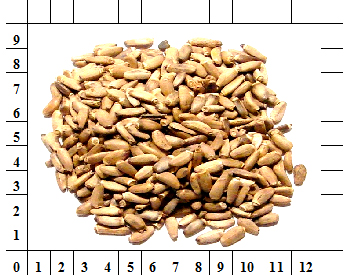
Milk thistle consists of dried mature fruit, devoid of the pappus of Silybum marianum (Fam. Asteraceae) .
Milk thistle contains not less than 1.5 per cent w/w of silymarin, expressed as silibinin calculated on the dried basis.
Category. Hepatoprotective, Cancer chemoprevention
Description. Fruits are elongate-obovate with smooth and shiny outer surface. They have an overall pale greyish or brown colour with no rancid odour.
Identification
- Macroscopic–The achene is strongly compressed, elongate-obovate, about 6-8 mm long, 3 mm broad and 1.5 mm thick, the outer surface is smooth and shiny with a grey or pale brown ground colour variably streaked dark brown longitudinally to give an overall pale greyish or brown colour; the fruit is tapering at the base and crowned at the apex with a glistening, pale yellow extension forming a collar about 1 mm high surrounding the remains of the style. Cut transversely, the fruit shows a narrow, brown outer area and 2 large, dense, white oily cotyledons.
- B. Microscopic–The powder is brownish-yellow with dark specks. Examine under a microscope using chloral hydrate solution. The powder shows the following diagnostic characters: fragments of the epicarp composed of colourless cells, polygonal in surface view, the lumen appearing fairly large or as a small slit, depending on the orientation, groups of parenchymatous cells from the pigment layer, some of them containing colouring matter which appears bright red, very abundant groups of large sclereids from the testa with bright yellow pitted walls and a narrow lumen, occasionally fragments of small-celled parenchyma with pitted and beaded walls, abundant thin-walled parenchymatous cells from the cotyledons containing oil globules and scattered cluster crystals of calcium oxalate, a few larger, prismatic crystals of calcium oxalate.
- Determine by thin-layer chromatography (2.4.17), coating the plate with silica gel GF254.
Mobile phase. A mixture of 8.5 volumes of anhydrous formic acid, 16.5 volumes of acetone and 75 volumes of methylene chloride.
Test solution. Reflux about 1.0 gm of coarsely powdered substances under examination with 50ml of methanol for 15 minutes ,cool and filter. Reflux the residue further with 2 x 50 ml of methanol, cool and filter. Combined all filtrates and concentrate to10 ml.
Reference solution. Reflux 0.5 gm of milk thistle RS in 20ml of methanol for 15 minutes, cool and filter. Reflux the residue further with 2 x 20 ml of methanol, cool and filter. Combined all filtrates and concentrate to 5 ml.
Apply to the plate 10 µl of each solution as bands 10 mm by 2 mm. Allow the mobile phase to rise 8 cm. Dry the plate at 100-105° for 5 minutes and examine under ultraviolet light at 254 nm. Spray the warm plate with a 1.0 per cent w/v solution of diphenylboric acid aminoethyl ester in methanol and subsequently spray with a 5.0 per cent w/v solution of macrogol 400 in methanol. Heat the plate 105° for 5 minutes and examine in ultraviolet light at 254nm and 365 nm. The chromatographic profile of the test solution is similar to that of the reference solution.
Tests
Foreign organic matter (2.6.1). Not more than 2.0 per cent.
Ethanol soluble extractive (2.6.2.). Not less than 3.0per cent.
Water soluble extractive (2.6.3). Not less than 12.0 per cent by Method I.
Total ash (2.3.19). Not more than 8.0 per cent.
Acid insoluble ash (2.3.19). Not more than 3.0 per cent.
Heavy metal (2.3.13). 1.0 g complies with the limit test for heavy metals, method B (20ppm).
Loss on drying (2.4.19). Not more than 8.0 per cent, determined on 1.0 g of the powdered drug by drying in an oven at 105º for 2 hours.
Microbial Contamination (2.2.9.). Complies with the microbial contamination test.
Assay. Determine by liquid chromatography (2.4.14).
Test solution. Reflux about 5 g of the powdered drug in a continuous extraction apparatus. Add 100 ml of light petroleum and heat on a water-bath for 8 hours. Allow the defatted drug to dry at room temperature. In a continuous extraction apparatus, extract the latter with 100 ml of methanol in a water-bath for 5 hours. Evaporate the methanolic extract in vacuum to a volume of 30 ml. Filter into a 50 ml volumetric flask, rinse the extraction flask and the filter, and dilute to 50 ml with methanol.
Reference solution. Dissolve a 10 mg of silibinin RS in methanol and dilute to 100 ml with the same solvent.
Chromatographic system
– a stainless steel column 12.5 cm x 4 mm packed with octadecylsilane bound to porous silica (5 µm),
– mobile phase: A. a mixture of 0.5 volumes of phosphoric acid, 35 volumes of methanol and 65 volumes of water,
- B. a mixture of 0.5 volumes ofphosphoric acid, 50 volumes of methanol and 50 volumes of water,
– a gradient programme using the conditions given below,
– flow rate: 0.8 ml per minute,
– spectrophotometer set at 288 nm,
– injection volume:10 µl.
Time Mobile phase A Mobile phase B
(in min.) (per cent v/v) (per cent v/v)
0 100 0
28 0 100
35 0 100
36 100 0
51 100 0
Inject the reference solutions. The test is not valid unless the resolution between silibinin A and silibinin B is not less than 1.8.
Inject the test solution and reference solution.
Calculate the percentage content of total silymarin, expressed as silibinin, using the following expression:
(A1+A2)× M2× P
(A3+A4)× M1
Where, A1 = area of the peak due to silibinin A in the chromatogram obtained with the test solution.
A2 = area of the peak due to silibinin B in the chromatogram obtained with the test solution.
A3 = area of the peak due to silibinin A in the chromatogram obtained with the reference solution.
A4 = area of the peak due to silibinin B in the chromatogram obtained with the reference solution.
M1= mass of the herbal drug used to prepare the test solution, in grams.
M2 = mass of silbinin RS in the reference solution, in grams.
P = percentage content of silibinin RS.
Storage .Store in air tight amber colour containers protected from light, heat and moisture.